Thursday, October 30, 2014

Happy Halloween!

Hello, Round Tablers. My quest to get spooky stories for this week's blog has meet with some success. Here is a quotation to get us started.


From The Reverend Ewald Shewkirk via Michael Newton:

"It was a wettish day, and it looked as if all was dead in the town." Mr. Shewkirk in New York, July 14, 1776." Now that sounds like it's worth investigating!


From Lynne Saginaw: The Rest of the Story: The Vilest Villain ...

Loring admitted he had misappropriated two-thirds of the allowance for prison food. He had an assistant by the name of Sergeant O'Keefe, who was probably in charge of almost 300 private, unofficial hangings ordered without trial.

On the 18th of January, 1777, George Washington wrote to Lord Howe on the subject of naval prisoners:
“…that I am under the disagreeable necessity of troubling your Lordship with a letter almost wholly on the subject of the cruel treatment which our officers and men in the Naval Department, who are unhappy enough to fall into your hands received on board the Prison ships in the harbor of New York:

"From the opinion I entertain of your Lordship's humanity I will not suppose that you are privy of proceedings of so cruel and unjustifiable a nature and I hope that upon making the proper inquiry you will have the matter so regulated that the unhappy persons whose lot is captivity may not, in the future, have the misery of cold, disease and famine added to their other misfortunes.

"You may call us Rebels, and say we deserve no better treatment, but remember, my Lord, that we still have feelings as keen and sensible as Loyalists and will if forced to, most assuredly retaliate upon those upon whom we look as the unjust invaders of our rights, liberties and properties.

"I should not have said this much, but injured countrymen have long called upon me to endeavor to obtain redress of their grievances, and I should think, myself, as culpable as those who inflicted such severities, were I to continue silent.”

Lord Howe’s answer was an evasive general denial of the charges. Howe was a poor disciplinarian, naturally lazy, who preferred the luxury and self-indulgence, and did not want to bother with investigations that might take up his time or reflect on the British army's administration in New York.

Loring was finally relieved of his position on charges of corruption and sent to England during the war. He died there shortly afterwards. But the damage was done.


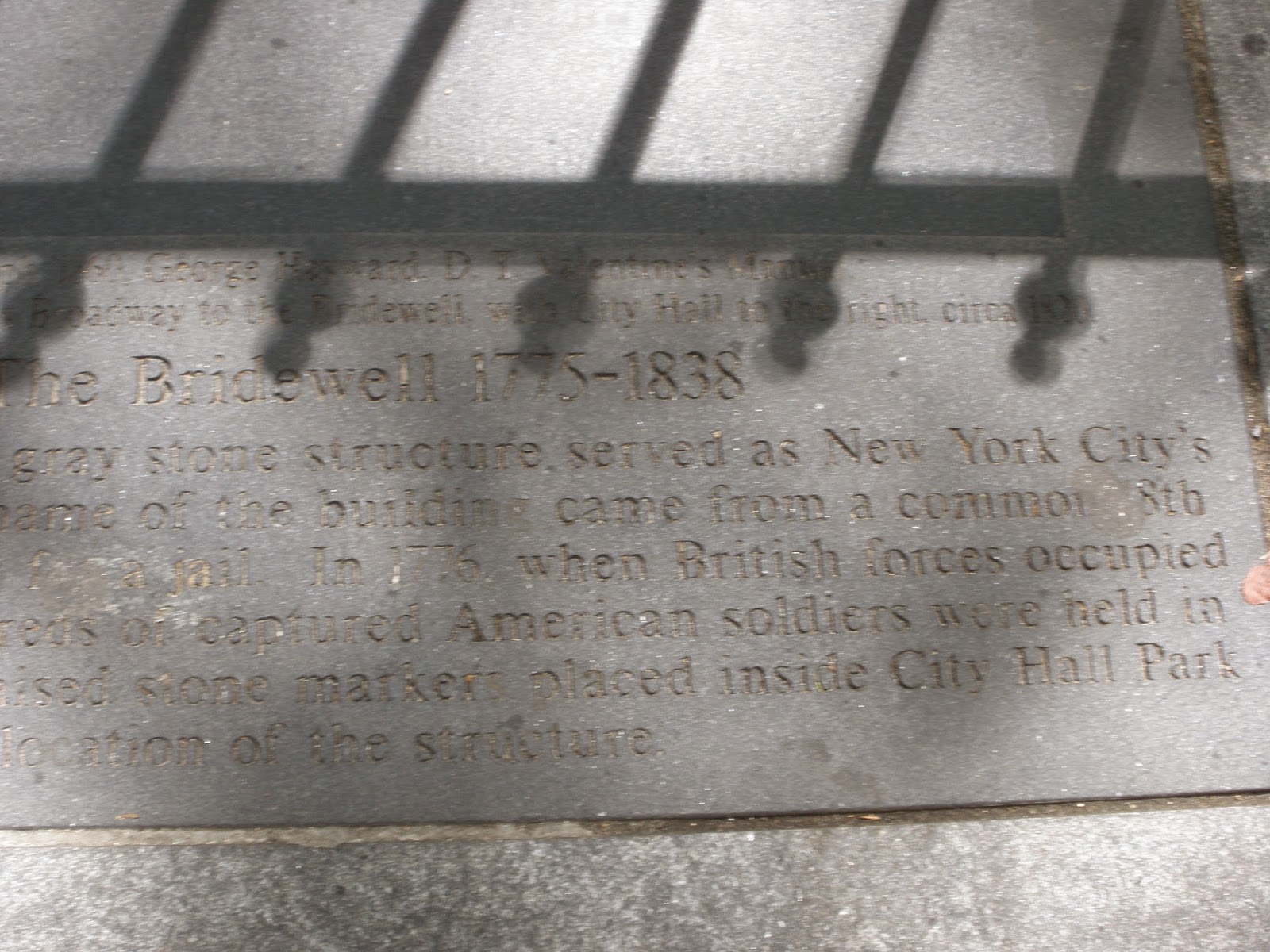
From Lower Manhattan, these photos of the long-ago Bridewell Prison

I recommend that you take a look for yourselves the next time you are in City Hall Park. Perhaps you'll feel the same tingle up and down your spine that I did.


Photos by Maria Dering


Tuesday, October 28, 2014

No Huzzahs Here for Joshua Loring, Jr.

Halloween is coming and our villains list features Joshua Loring, Jr.  Here is what Lynne Saginaw dug up about this nefarious scoundrel.  

The Vilest Villain of All: Joshua Loring, Jr.

Americans like to see ourselves as the good guys: occasionally mistaken, but always honest and well-meaning. The refutation of the argument goes back to the earliest days of America. It exists in the person of Joshua Loring, Jr. (1744-89), mass murderer and paragon of corruption.
Prison ship Jersey
In the public domain; courtesy of www.wikipedia.com
In the entirety of the Revolution, a total of 4,300 American men were killed in battle. Three times as many, roughly 13,000, died on the infamous British prison ships and in warehouses and factories commandeered by the British in New York and elsewhere. And Joshua Loring was largely to blame.

American prisoners died like rats, of disease and hunger. In summer, they suffocated and they froze to death or died of pneumonia in winter. With little food and water, prisoners had no strength to resist dysentery, typhoid, smallpox, yellow fever, and tuberculosis. The food was often putrid.

From Commissary Joshua Loring, Provost Marshal William Cunningham, and Naval Commissary David Sprout, down to the lowly prison guards, no one acted to prevent the virtual annihilation of these prisoners of war. The story differed little in prisons in Charleston and Savannah. The policy appears to have been a deliberate conspiracy not only among the prison commissaries, but actually by the British High Command.
Wallabout Bay
The victims were buried in the sands of the adjacent shore of Wallabout Bay, where the Navy Yard in Brooklyn is now located. Twenty years after the war, a vast number of the bones were dislodged. They were collected by Captain John Jackson, the proprietor of the neighboring land, and re-interred at his expense.

When they evacuated New York, the British tried to cover up their responsibility. But the evidence was there, contained in letters written by prisoners who survived. There was also the word of escaped and exchanged prisoners. And there was the report made by Elias Boudinot, appointed by Congress to secure the exchange of prisoners, provide them with clothing and food, and investigate the situation in some of the New York prisons.
Howe had a direct link with Commissioner Loring, whom he appointed. Loring was a Boston Loyalist and a contemptible example of greed and graft. He is perhaps most famous for selling his wife Elizabeth Lloyd Loring (1744-1838) to Howe to secure the appointment. This arrangement was widely known at the time, and made the Lorings the subject of some of the more ribald lyrics of the day.

Visit us on Halloween for the rest of the story.

Sources:
http://longislandgeneaology.com by Brock Fleming

www.wikipedia.com
www.usmm.org (The Merchant Marine website has lists of the names of prisoners)

Thursday, October 9, 2014

Our Meeting on Tuesday, October 7, 2014

Rarely do I add personal musings to a blog of this kind, but I would like to share my observations on Tuesday night's meeting.  

In my experience, groups interested in history (whether local, state, or national) tend to skew toward an older demographic.  In the past, the ARRT-NY was no exception to the rule. (That is just a statement of fact, not a value judgment.)  However, I have noticed over the past few years that we are -- happily -- attracting a much more diverse group in terms of age and background.  On Tuesday evening, we welcomed our youngest attendee ever, who even took a lively part in our book and flag auction.

It is a pleasure to see so many different kinds of people interested in American history, especially the history of the Revolution that often takes a back seat to the Civil War.  So please do encourage your friends, neighbors, colleagues, and family members to try a Round Table event soon.  You'll find us on Facebook, on this blog, and at our website, www.arrt-ny.org.  We are a friendly group!

Sunday, October 5, 2014

From Our Library

Now that autumn is in full swing, why not take a break from your busy schedules and pick up a good book?  Our Book Review chair Lynne Saginaw shares her thoughts on a few good ones here.  Thank you, Lynne, for this very helpful list.

What I Read This Summer
Now that I’ve retired, I’m a full-time reader. Here is a partial list of Revolutionary War titles I read over the summer; they will make good reading for those fast approaching cold autumn evenings.

Pulitzer–Prize winner Joseph Ellis’ excellent Revolutionary Summer: The Birth of American Independence is just out in paperback from Vintage ($15.95). Those risky, dramatic days are brought vividly to life in a short, snappy text you’ll find hard to put down, even though you already know how it comes out. The summer of 1776, culminating in the Battle of Brooklyn, makes for thrilling reading. Originally published by Knopf at $26.95.

From great events to what the women of the era made of them: turn to Dear Abigail: the Intimate Lives and Revolutionary Ideas of Abigail Adams and her Two Remarkable Sisters by Diane Jacobs. You may never have heard of Mary Cranch and Elizabeth Shaw Peabody, the older and younger sisters, respectively, of Abigail Adams, but they lived lives of substance. All three were devoted correspondents, and their letters illuminate the times with an intimacy that is by turns touching and instructive.


This volume, published 2014 by Ballantine Books, suffers from some inconsistent editing, including a few wince-making spelling errors by the author (I don’t mean the oddities of Colonial–era spelling, well known to history readers), and some of Ms. Jacobs' conclusions strike this reviewer as naïve, but the life stories of the principals are so compelling that you shouldn’t let these lapses stop you from enjoying this book.

One of my favorite essayists, Simon Winchester, tackles the history of America’s infrastructure in The Men Who United the States. The colonial and immediate post-revolutionary periods are not a big part of this eccentric and charming volume -- part memoir, part history, part travelogue -- but you won’t want to miss Winchester’s section on George Washington’s efforts at canal-building. (HarperCollins, 2013)

When I was a kid, there was a saying: “make new friends but keep the old.” One old friend they’ll have to pry out of my cold dead hands is David McCullough’s classic John Adams. Published by Simon and Schuster in 2001 (at $35.00), this is a brilliant compendium of everything you need to know about this Founding Father, written with clarity, depth, and love for this difficult man. McCullough is rightly deemed the dean of popular historians. Even the most history-averse will fall for this one, assuming its heft doesn’t scare them off. Make it a dare, and win twice over.

Another past winner revisited was Richard D. Blackmon’s Dark and Bloody Ground, published in 2012 by Westholme ($29.95), a solid niche publisher of American history. This book was a finalist of ARRT’s book award that year. Not for the general reader, it details with exhaustive care the war along the southern frontier among Native peoples, colonists, and Europeans. If you are interested in the war in the South or in the beginnings of American policy towards the first Americans, this should be on your shelf. Otherwise, any one of the other books cited will serve you better.


Get thee to a library.
 Preview of Coming AttractionsPotential reviewers are hereby alerted that the October 7th meeting will feature these four books for review. Only members not currently on assignment are eligible.


The Return of George Washington, 1783-1789 by Edward J. Larson
American Spring: Lexington, Concord and the Road to Revolution by Walter R. Borneman
Brandywine: A Military History of the Battle that Lost Philadelphia by Saved America, September 11, 1777 by Michael C. Harris
Band of Giants: The Amateur Soldiers Who Won America’s Independence by Jack Kelly (a Round Tabler himself!)
 

Hope to see many of you on Tuesday at our October 7th dinner meeting!

Tuesday, September 23, 2014

Our October Meeting: David W. Young Speaks about Cliveden

Hello, Round Tablers.  Our fall season starts with an exciting meeting on Tuesday, October 7. 

Here are the details; click on the images to enlarge them.

From our October newsletter, Broadside
Please remember to make a reservation in advance of October 7.  For more about Cliveden, visit http://www.cliveden.org/  And join us on October 7th!

And while you're at it, you can easily renew your membership for 2014-2015 by mailing in the form or completing it and bringing it with you on October 7.  Here's the form, which is also available on our website at http://arrt-ny.org/ARRTDuesForm2014-2015.pdf  You can print the enlarged image or the image from the website by typing CTRL+P on your PC.  (Mac users -- you're on your own!)

We think this is the best deal around!
Membership has its advantages:  special rates for our great dinner events; a copy of the Broadside mailed to you five times a year, reminders of special events.  It's a great time to join the Round Table!

For more information, take a look at our membership flyer:

See you soon!

Tuesday, September 16, 2014

Mid-September Round-Up

Here are some tidbits from history and current news for Round Tablers and friends.

British Troops Landing at Kip's Bay
In the public domain; courtesy of www.wikipedia.com
Round Tabler Richard Melnick wrote yesterday, 9/15: "Kip's Bay Invasion Day
On September 15, 1776 British warships in the East River bombarded American positions around Kip's Bay, Manhattan (York Island), allowing British and Hessian troops, who boarded flatboats on Newtown Creek at Long Island, and invaded our fair city's shores ...".  Thanks, Richard.


Jack Kelly reports on his new book:  "Band of Giants: The Amateur Soldiers Who Won America’s Independence is now officially available in stores."  I hope it’s an enjoyable, exciting and informative narrative about the Revolutionary War and the “forgotten founders” who fought the war.

"The best source of information about the book is: http://bandofgiants.org/"
Thanks, Jack.  We hope Round Tablers (and friends) will enjoy the book!  Post comments here or on Facebook.  


U.S. 10-cent commemorative stamp
Issued 1975; image in the public domain
Lynne Saginaw reports on a timely item:  Unsung Hero, 5775 Edition:   Haym Salomon
Whether or not you’re celebrating the upcoming Jewish New Year, here’s the story of an American patriot we should all know.

Haym Salomon (or Solomon; April 7, 1740 – January 6, 1785) was a Jewish American broker who immigrated to New York from Poland. He helped convert French loans into ready cash by selling bills of exchange for Robert Morris, the colonies’ Superintendent of Finance. Salomon was the prime financier of the Revolution.

Haym Salomon was born in Leszno (Lissa) Poland in 1740 to a family, originally Spanish and Portuguese, who migrated to Poland and lived there for many generations. During his travels in Western Europe, he acquired knowledge of finance as well as fluency in several languages. He returned to Poland in 1770 but left for England two years later. In 1775, he came to New York, where he established himself as a financial broker for merchants engaged in overseas trade.

Sympathetic to the Patriot cause, Salomon joined the New York branch of the Sons of Liberty. In September 1776 he was arrested as a spy. The British pardoned him, but only after holding him for 18 months on a British ship, to use him as an interpreter for their Hessian mercenaries. Salomon used his position to help prisoners escape and encouraged the Hessians to desert. In 1778 Salomon was arrested again and sentenced to death, but he managed to escape, and made his way with his family to Philadelphia.

Once resettled, Salomon resumed his activities as a broker. The Continental Congress was struggling to raise money. It had no powers of direct taxation and had to rely on requests for money to the states, which were mostly refused. The government had no choice but to borrow. ...

For more about Haym Salomon and his service to the Republic, visit http://en.wikipedia.org/wiki/Haym_Salomon and www.nps.gov/amrev.  If your taste runs to hard copy, you might want to read William Pencak's book, Jews and Gentiles in Early America, 1654-1800.

Friday, September 5, 2014

Unsung Hero: Dr. David Hosack and the Medicinal Garden

Where Rockefeller Center stands now in midtown Manhattan was once the location of one of the outstanding medical facilities of the immediate post-colonial era. Not a hospital, but a garden. Dr. David Hosack, who also designed the garden at Hamilton Grange, planted it, beginning in 1801. Here is his story, as contributed by the indefatigable Lynne Saginaw (Chair, ARRT-NY Book Review Committee).
Portrait of Dr. Hosack by Rembrandt Peale, 1835
In the public domain; courtesy of www.wikipedia.com
Born August 31, 1769, 245 years ago this week, David Hosack is perhaps best known as the doctor who tended Alexander Hamilton after his duel with Aaron Burr. Born in New York City, Hosack attended Columbia College, where he began as a student of art, but became fascinated by medicine. He apprenticed with Dr. Richard Bayley.
Hosack transferred to the College of New Jersey, today's Princeton. He graduated in 1789 and enrolled for further study under Dr. Nicholas Romayne. In the fall of 1790 Hosack transferred to the University of Pennsylvania Medical School in Philadelphia, where he wrote a doctoral dissertation on cholera. He received his medical degree the following spring, and moved to Alexandria, Virginia, where he opened his first practice.

He’d learned that the best practitioners received at least some of their schooling in Europe, so his father agreed to pay his way to Britain. Hosack attended the University of Edinburgh, where he spent much of his time in botanical gardens.

Shortly after his return to America, Hosack's son died. His wife soon followed, in childbirth. These tragedies, and the epidemics of yellow fever in Philadelphia in 1793 and New York in 1795 and 1798, led Hosack to devote much of his life to the expansion of medical knowledge and education, and to the training of doctors in caring for women and children. He helped found Bellevue Hospital.

Hosack was appointed professor of natural history at Columbia College in 1795, and in 1797 succeeded to the chair of medicine. By 1801 he was a Professor of Botany at Columbia. In 1807 he was named professor of midwifery and surgery in the College of Physicians and Surgeons, later occupying the chairs of the “Theory and Practice of Medicine” and of “Obstetrics and the Diseases of Women and Children.”

Always an innovator, he was one of the first physicians to use a stethoscope, and a strong advocate of smallpox vaccination. Hosack made great progress towards combating yellow fever, and was the first to make an accurate description of its symptoms. He and Nicholas Romayne worked to found several new medical schools. One of his early accomplishments was the merger of the College of Physicians and Surgeons and Columbia.

In 1801, Hosack purchased twenty acres of land in New York for $4,807.00. At the time, the land was in a rural area, three and a half miles from the city limits. Elgin, as it was called, was the first public botanical garden in the United States. At his own expense, Hosack landscaped the garden with a variety of indigenous and exotic plants. By 1804, the garden was home to 1,500 species of plants, the majority of American origin.

In addition to an enormous variety of plants, the garden contained an expansive greenhouse, two hothouses, and a pond for the propagation of aquatic species. It soon proved too expensive for even a man as prosperous at Dr. Hosack to run properly.

The New York Legislature passed an act in 1810 that allowed the State of New York to purchase the Elgin Botanical Garden. Care of the garden was placed in the hands of the State Regents, who did not share Hosack’s foresight. The garden was abandoned in 1812, fell into decay and was sold to raise funds for Columbia.

After his wife Catharine died, Hosack married Mary Eddy of Philadelphia, with whom he had nine children—seven of whom survived to adulthood.

Hosack was the founder and first president of the New York Horticultural Society, the first such organization in America. He was president of the Literary Society and the Philosophical Society, one of the founders of the New York Historical Society—and its fourth president (1820–1827).After Mary died in 1824, he married Magdalena Coster, widow of a friend and mother of seven. The families were combined with success, living on Chambers Street and at a country estate on Kip’s Bay—both part of the Coster inheritance. Every Saturday, the Hosacks hosted a salon for leading artists and intellectuals as well as medical men, and they became known as social leaders in the city. Hosack was a patron of American artists including Samuel F. B. Morse, inventor of the telegraph, and Thomas Cole.

In later life, with Coster family assets, Hosack was able to purchase the famous Hudson River estate of Hyde Park, former home of his teacher and partner in medical practice, Dr. Samuel Bard, and there he developed another fine botanical garden. The Hosacks’ opulent home became popular with visitors who enjoyed the beauty of the Hudson River valley, including not only painters and naturalists but the writer Washington Irving.

He died tragically, of a stroke, only days after a fire destroyed his New York property, on December 22, 1835.

Sources: 
Hosack, Alex Eddy, M.D.  Lives of Eminent American Physicians and Surgeons of the Nineteenth Century.  Samuel Gross, ed. 1861.  Dr. Alex Hosack was the son of David Hosack.
Magnet, Myron. The Founders at Home: The Building of America, 1735-1817.
www.wikipedia.org
Dictionary of American Biography
http://libweb.lib.buffalo.edu (website of the Robert L. Brown History of Medicine Library at the University of Buffalo)